The internet is a commodity that has grown to be labeled both a gift and a curse. In the case of scholarly usage, this is no anomaly. In recent years, students and educators alike have pondered the possibility of effectively using the internet, and its many perks to boost the educational experience. On the one hand, Kathleen Fitzpatrick argues that the benefits of using the internet for scholarship outweigh the costs. From this perspective, in her article “Reading (and Writing) Online, Rather Than on the Decline,” she claims that the internet is where the future of education lies. On the other hand, however, Nicholas Carr argues that the internet has been corrupted to the point that using it for scholarly purposes would not be beneficial for anyone. In his article, “Is Google Making Us Stupid?” he states that, “A style of reading promoted by the Net, a style that puts ‘efficiency’ and ‘immediacy’ above all else, may be weakening our capacity for the kind of deep reading that emerged when an earlier technology, the printing press, made long and complex works of art commonplace.” In sum, then, the issue is whether or not the internet can be of good use in the realm of education, and scholarship? I say yes it can, and should! If used responsibly, and with integrity, the internet can be a truly engaging way to reach the minds of the new generation of students that books are losing the ability to do. A prime example of this is a website called Quizlet. I have had many a test scores saved by practice tests and flashcards created by myself or shared by others. It is a great space to share studying material that I used all throughout my high school career. If we could incorporate the concepts behind sites like Quizlet into other areas of the scholar’s internet, then sky is the limit
The issues surrounding using internet for schools range from the most elementary of concepts to the more difficult ethical quarries. On the simpler side, the internet is a place of distractions galore. In his article, Carr alludes to the fact that the simple nature of the internet is chipping away my capacity for concentration and contemplation.” As an active user of the internet, I will be the first one to admit the worldwide web’s ability to suck the user into a vortex of distractions catered to your liking. For example, Quizlet would have sportswear ads flashing on the side of my screen, which often grabbed my attention. But as we all know, it is easier to focus on efficiently using the internet for any task if there is a purpose behind it. On the more complex side of reasons against in this debate, is the issue of ownership. As much as we want to trust society, it would be foolish of students and educators to believe that stealing and acts of plagiarism don’t occur quite often in the informational and scholarly sectors. This harsh truth rouses a number of questions: Do you really have sole ownership of what you post to a domain, blog etc.? And is it a worthy use of student’s time to publish their work to an area where agency of their own work is a question? On Quizlet, your profile was connected to any material you posted; meaning that anyone who used your study materials knew it was your work. But at the same time, that doesn’t mean someone couldn’t just as easily copy, paste, and print your work to claim it as their own. Honor and integrity play large roles in the control of this problem.
On the other side of this argument are those who are willing and ready to usher in a new generation of technological and educational advancement. The generational gravitation towards scholarship on the web is largely due to one simple fact: the traditional ways of doing everything on paper are getting boring! New, more interactive and engaging ways to incorporate scholarship online will be able to keep up with the forever updating image of today’s pop culture internet that commands students’ attention outside of the classroom. A 30 second matching game on Quizlet has been far more effective at drilling vocabulary into my head than the traditional textbook methods. To reinforce this, Kathleen Fitzpatrick herself that argues that people haven’t stopped reading “civic literature” and other educational readings. They simply have turned away from paperback versions of these works, and found the online versions of these topics.
The safety that comes with tradition is reassuring to many. And although I agree with Fitzpatrick and her beliefs about technology and scholarship’s coexistence, I can’t help but acknowledge the safety found in the usage of books in education. Albeit paper-and-pencil methods of teaching have succeeded in preparing scholars for the world they enter, but times are changing now, more so than ever before. It would be in the best interest of educators to realize that their methods of teaching should change accordingly. However, an effort of this large a scale cannot be accomplished by just one party. All members, from teachers and professors, to students, and others who may play a key role (i.e. technological specialists in these academic institutions) must work in unison to foster change necessary to. It is not just up to the educators to come up with ways to use this resource creatively and effectively. But it’s also up to the students to engage, and fully buy into this new method of learning. If we, as a society can guarantee this in a simple majority, then the future is looking bright for this dynamic tool’s use in the classroom.
Works Cited
-Carr, Nicholas. “Is Google Making Us Stupid?” The Atlantic, Atlantic Media Company, 13 June 2018, https://www.theatlantic.com/magazine/archive/2008/07/is-google-making-us-stupid/306868/.
-Fitzpatrick K. (2014) Reading (and Writing) Online, Rather than on the Decline. In: Segal N., Koleva D. (eds) From Literature to Cultural Literacy. Palgrave Macmillan, London
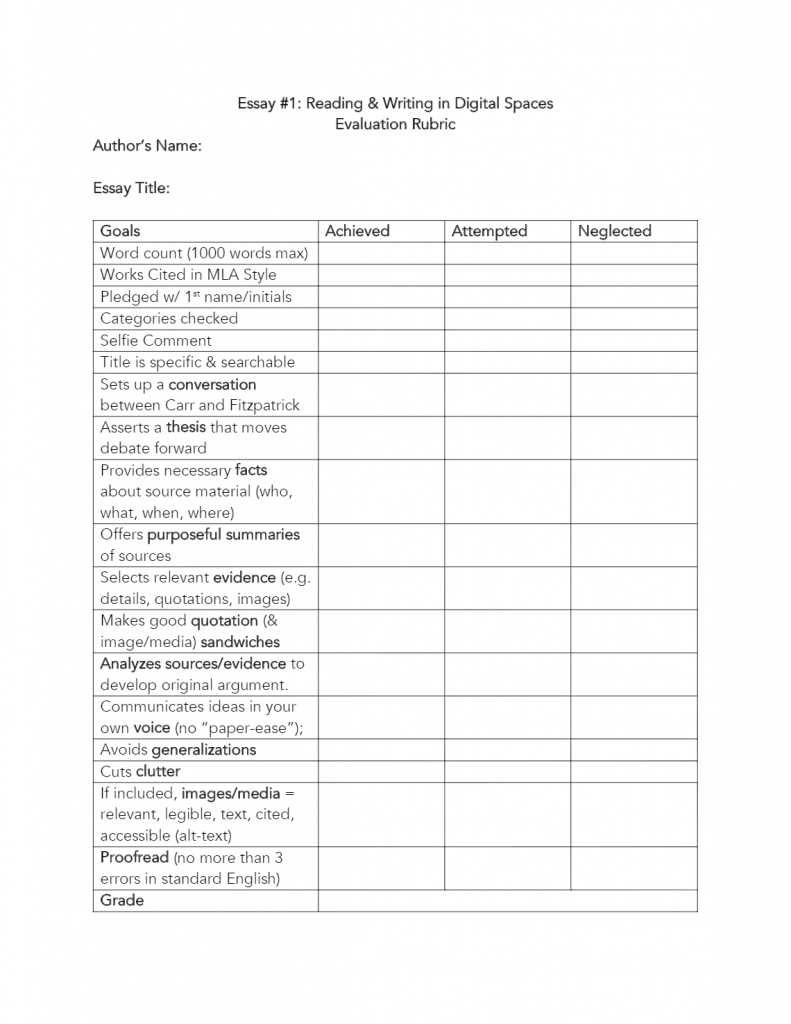


What I want to emphasize is that you’ve mastered the conversational model and figured out how to draw upon your own experience (data, evidence) to deliver an original argument. In fact, you’re so good at setting up the conversation that you’re poised now to dig into your sources and engage more deeply with what they have to say and how it relates to your argument!
Please also change your discussion settings so we don’t have to add name and email.