Magic Doors and their ability to enhance the refugee experience in Moshin Hamid’s “Exit West”

The issue regarding refugees and how to deal with excess numbers of them is very relevant, and very real. In his speculative fiction novel, Exit West, Moshin Hamid provides a very real insight into the lives of these refugees through the eyes of Saeed, and Nadia; two people from a war torn country in the Middle East. In her article, “What it feels like to be on the other: imaginations of displacement in contemporary speculative fiction,” Eva Menger argues that it is through the concepts of space, time, and the novum that Hamid is able to most effectively provide insight into the refugee experience. He also argues that speculative fiction is the best way for readers to “imagine the world of refugees in ways that in ways that other types of contemporary literature cannot.” As much as I agree with Menger’s two claims, I cannot help but wonder if there are more than just 3 tools/themes that Hamid used in his article to help provide this insight. When I read the book, the recurring theme that stuck out to me was the magic doors that allow people to travel from place to place in a matter of seconds. In the case of Hamid’s Exit West, I will argue that the theme: magic doors is a concept that further enhance the effectiveness of time, space, and the novum that Eva Menger claims help provide insight into the refugee experience.

The fact that Exit West is a Speculative Fiction play an important role in shaping our perspective of the novel. Menger articulates that it is the genre’s ability to “encourage their readers to swap reality for an alternate universe” which “can ultimately offer new ways of imagining the refugee experience” that is so essential to this story. Creating a new universe is what allows Hamid to basically start from ground zero with regards to creating circumstances that best illustrate the full experience of the refugee. He is able to manipulate whatever variables of reality he so wishes. More specifically for this novel, Menger claims that the “otherness” associated with the alternate realities the genre can create allow for the reader to distinguish Hamid’s refugee experience from what they know to be real.  Menger articulates, “that this strong focus on Otherness only further enforces the image of the refugee as Other,” which makes the concept itself more foreign to the reader, so they can trust that the refugee experience Hamid is selling them is accurate and authentic. In other words, the genre of Exit West allows for the three aforementioned concepts to be manipulated in a way that pushes Hamid’s agenda.

The term “Novum” is an interesting concept in itself. It is defined as the concept of representing science in the real world, so that the reader may then establish a safe distance from their reality outside of the novel. This distance the reader creates for this novum to exist is known in Menger’s article as Cognitive Estrangement. The magic doors that are used frequently throughout the book represent a world with open borders, where travel without restriction is reality. They also represent the hope for a better future that many of the refugees in the book hold close to their hearts. Although portal doors are not a part of the real world, the concept of them is still feasible. The elements of fantasy associated with the door allow for readers to establish this space for the novum to exist in full effect. Therefore by allowing the reader to easily create this novum space, the doors have served their purpose in enhancing the novum’s ability to provide insight into the refugee experience.

Time in the novel is distorted, and manipulated by the magic doors. The uncanny ability to travel hundreds, even thousands of miles in a matter of seconds makes time a non-limiting factor. And in the grand scheme of Speculative Fiction, the less limiting factors you have, the easier it is for a new reality to be created for the reader. Menger believes that “this, expectedly, is why most speculative fiction chooses futuristic scenarios over present parallel worlds.” In the case of Exit West, Hamid actually combines the two aforementioned time constructs. Saeed and Nadia are living in a present parallel world in many aspects, but the magic doors make the scenario futuristic in a sense. In Exit West, Hamid says that “we are all migrants of time” in an effort to create a common ground between the reader and the refugees encountered in the novel. And the magic doors are what help represent this migration in the book, not just through time, but through space as well… 

According to Eva Menger, space is what “allows the reader to take a step back from reality.” With this in mind, the aforementioned novum and space are very similar in more ways than one. This means that since the novum is enhanced by magic door’s ability to create a divide/space between the reader’s reality and the novel’s reality, so too is the space itself. But on top of this enhancement, I believe that space is able to further immerse the reader in the book by creating such separation between realities. On this matter, Menger claims, “Looking at Exit West and American War, these lands are not just far away from us in a geographic sense, but they are equally far removed from our psychological reality. For many people the refugee narrative is a foreign one, making it hard to understand what living in exile must be like, and speculative fiction can bridge this gap by literally bringing the refugee narrative closer to the reader’s reality.” Essentially she is saying that there exists the reader’s reality and the reality of the refugees in the novel, and the genre, speculative fiction is the reader’s bridge between the two. Since space, time, and the novum are how Hamid takes advantage of speculative fiction’s role in the refugee experience. Meanwhile, magic doors are what enhance the effects of those three concepts. Therefore, it is safe to say there is some relationship between the magic door’s role in the book, and its betterment of the gap-bridging that Menger discusses.
Moshin Hamid’s Exit West may not provide the answer for solving the refugee crisis, but the novel’s role in providing perspective and insight on the topic could greatly further disputes about the issue. As a speculative fiction novel, Hamid was able to create an alternate reality in which he could manipulate the circumstance itself in order to best illustrate the refugee experience. According to Eva Menger, he does this through the manipulation of three concepts dealing with reality: Space, Time, and the Novum. I went on to argue that these three concepts were bettered by Hamid’s use of magic doors throughout the novel, which allowed the characters to travel from country to country in a matter of seconds. The doors only made Hamid’s ability to show the refugee experience that much stronger. The more effective Hamid is at accomplishing that task, the better off the novel is at affecting the minds and hearts of its readers.
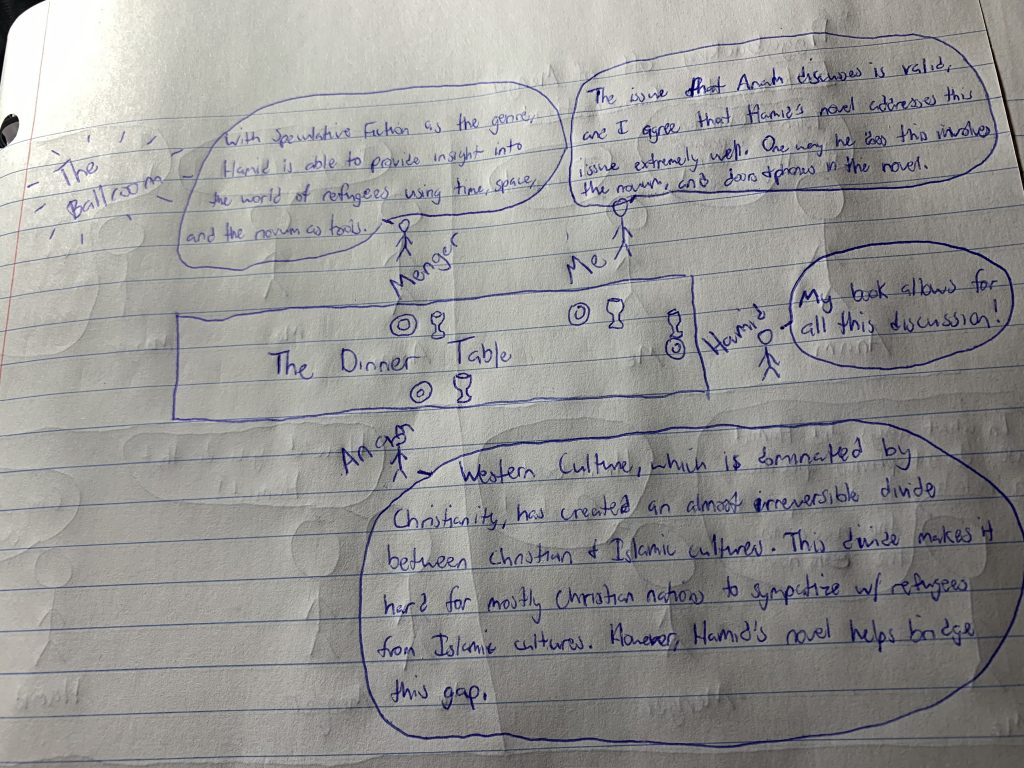
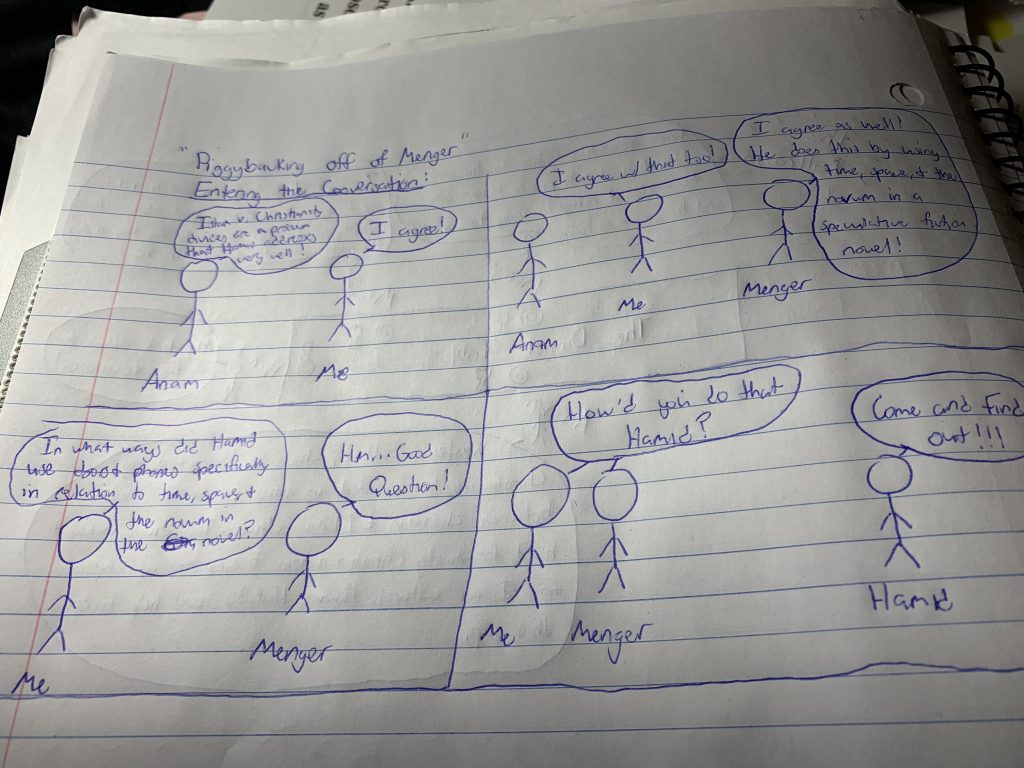
Entering the Conversation: My Ballroom Map

Ballroom/State Dinner Map
My Plan: Piggybacking

Introductory Paragraph:

The issue regarding refugees and how to deal with excess numbers of them is very relevant, and very real. As the news, social media, and scholars alike display and debate these tragedies, neighboring nations continue to consider what their role should be in fostering, or reducing tension for these refugees.  Meanwhile, we, as individuals, are stuck somewhere in the middle with all this information on our screens and at our fingertips… But what to make of it all? In his speculative fiction novel, Exit West, Moshin Hamid provides a very real insight into the lives of these refugees through the eyes of Saeed, and Nadia; two people from a war torn country in the Middle East. In her article, “What it feels like to be on the other: imaginations of displacement in contemporary speculative fiction,” Eva Menger argues that it is through the concepts of space, time, and the novum that Hamid is able to most effectively provide insight into the refugee experience. He also argues that speculative fiction is the best way for readers to “imagine the world of refugees in ways that in ways that other types of contemporary literature cannot.” As much as I agree with Menger’s two claims, I cannot help but wonder if there are more than just 3 tools/themes that Hamid used in his article to help provide this insight. When I read the book, two recurring themes that stuck out to me were the usage of phones and the magic doors that allow people to travel from place to place in a matter of seconds. In the case of Hamid’s Exit West, I will argue that the two themes: phones and doors are concepts that further enhance the effectiveness of time, space, and the novum that Eva Menger claims help provide insight into the refugee experience.

Losing Yourself: How Alison Bechdel Elicits Insight Through Sympathy In “Fun Home”

As easy as it is to lose yourself in the plot of a good book, it seems as though you are always urged to take a step back, and look at the bigger picture. Whether you just finished a book, or made a mistake that caused your team to lose game, there is always some theme or lesson embedded in the aftermath to be discovered. It is usually the job of the participant to figure out exactly what that big takeaway is, and apply it to their daily lives. However the more invested you become in the thing itself, the more difficult it becomes to disconnect and realize these lessons. In Alison Bechdel’s Graphic Memoir, Fun Home, she tells the story of her childhood, and how she navigated the ins and outs of life as a queer woman, as well has her father’s untimely death, which she believes was self-inflicted. As a reader, I was amazed at how effective Bechdel was at casually discussing such controversial adult topics as queer identity, and suicide in a manner and style that we often associate with childhood play (Graphic Novels). It allowed for me to get so invested into the plot and the feelings that the characters were going through, that afterwards I found it extremely difficult to find the themes or lessons Bechdel could have wanted the reader to take away from the story. So I began thinking: what if there wasn’t a larger lesson for us? I believe that in her graphic memoir, Fun Home, Alison Bechdel actually didn’t leave a message for the readers to take away; instead, she merely provided insight on discovering one’s queer identity and suicide, thus allowing the reader to relate to her struggle from her perspective. She is able to create this sympathy within the reader allowing the them to relate to the more common aspects of her childhood, so that you can then at least attempt to sympathize with the less relatable feelings associated with her queerness, and interesting family history.

As mentioned before, the strategy Bechdel uses in her graphic memoir is to provide insight through sympathy she elicits in the reader. Initially, this sympathy is elicited by relating the reader to more common feelings that the character experiences, so that they can then sympathize with the less common ones. The first part of using more common life experiences is the simple part. Jennifer Lemberg offers an interesting insight into the science behind Bechdel’s uncanny ability to intertwine the reader’s emotions with those of her younger self. An important concept to understand that Bechdel appears to have mastered to enact this strategy is the relationship between pictures and dialogue. On this issue, she claims, “photographs prove difficult to decipher, while overidentification with literature by and about other people threatens to throw lives off course.” She continues, “By framing each of her chapters with words and images that bear a complex relationship to each other, Bechdel reminds us that it is in the space between existing visual images and familiar storylines where we make meaning of our individual lives.” In other words it is Bechdel’s word and picture choice combined that causes the feelings that further immerse the reader into the plot of the memoir, thus creating that sympathy. It is the discussions about Bechdel’s family vacations, playing with childhood friends, and writing in a diary that allow the reader to “make meaning of our individual lives” and connect with the protagonist/narrator. The consistency with which she alludes to these commonalities is what sets up the more challenging part for the reader to comprehend. the lesser understood problems that make Bechdel’s upbringing so unique: her queerness, and her father’s death.

When it comes to eliciting these same senses of sympathy and relatability surrounding her less relatable struggles, the author/character Bechdel is sure to compare her less comprehensible struggles to more relatable ones. When the character Bechdel returns home from college, she actually discusses her sexuality for the first time with her closeted father. She describes her feelings regarding the situation, stating, “I kept still, like he (her father) was a splendid deer I didn’t want to startle (220).” She then goes on to claim the conversation, “was more like fatherless Stephen and sonless Bloom… having their equivocal late-night cocoa at 7 Eccles Street (221).” The author Bechdel first compares the unwavering awkward silence in the conversation to the more common concept of not wanting to disturb a deer. She then compares the conversation as a whole to that of two fictitious characters, Stephen and Bloom in the book, Ulysses, alluding to the fact that they were able to harp on many similarities. Bechdel masterfully takes this uncomfortable, uncommon exchange, and uses more relatable sensations, and a literary allusion to create this aforementioned sympathy. 

What’s important to notice in each of the many cases where she must use this strategy of sympathy to provide insight is that she never tries to make a lesson out of it. At the very most, she will reflect upon her own feelings, thoughts, and actions in hindsight. But she never appears to have this big message for the reader to take away and reflect upon. When reflecting on her father’s death, and whether or not she believes he was a “good father,” she says, “It’s true that he didn’t kill himself until I was nearly twenty. But his absence resonated retroactively, echoing back through all the time I knew him. Maybe it was converse of the way amputees feel pain in a missing limb (23).” Not only does Bechdel reflect on her feelings towards her father’s alleged suicide, but yet again, she manages to relate it to a more understandable concept regarding amputees. Her self-reflection allows for the insight she is providing the reader with to almost be analytical of itself, thus, making it more engaging for the reader.

In many works of art, it seems that there’s always a big lesson its creators leave for us to apply to our lives. But sometimes, there is a hidden beauty in appreciating the work for what it is, allowing yourself to almost let lost in it’s intricate details. In her graphic memoir, Fun Home, Alison Bechdel is able to create this exact sensation. By allowing the reader to buy into the plot, and the protagonist’s feelings, she is able to draw the reader into the complicated story. This then allows her to relate the reader to the character’s more relatable experiences, so that they can attempt to sympathize with the character Bechdel’s less relatable experiences regarding her queer identity, and her father’s unexpected suicide. While all this is happening, the reader is never expected to take a step back to reflect on some bigger lesson or concept. Due to this observation, I think it is safe to say that apart from insight on the struggles of her upbringing, Bechdel didn’t have anything she wanted us to take away from the graphic memoir. And with the state of the world we currently live in, perhaps this style of writing is a beneficial and more effective; especially when discussing such complex, and controversial topics.

Works Cited

-Bechdel, Alison. Fun Home: a Family Tragicomic. Houghton Mifflin, 2007.

– Lemberg, Jennifer. “Closing the Gap in Alison Bechdel’s Fun Home.” WSQ: Women’s Studies Quarterly, The Feminist Press, 2 June 2008, https://muse.jhu.edu/article/238093. 

-Karr-Cornejo, Katherine. Rocky Mountain Review, vol. 68, no. 1, 2014, pp. 83–85. JSTOR, www.jstor.org/stable/24372799.

Zoom-In’s and Pan-Out’s: How Alison Bechdel Can More Effectively Get Her Message Across in “Fun Home”

If you’ve ever been a part of a controversial conversation, you know how difficult it can be accepting some of the harsh truths that are associated with such topics. What’s just as important to anyone who is receiving this sort information, is the fashion in which this package of information is delivered. It is essential to strategize the order, style, and tone behind its delivery that most effectively conveys this information to the audience in a way they can understand fully. But the task can become significantly more difficult in certain situations: what if you don’t necessarily know who your audience is? What if your controversial topic is so hard to relate to, that people lose interest in what you have to say? I would imagine these are some of the exact issues that author Alison Bechdel encounters through her work; particularly in her famous graphic novel, Fun Home. The controversy surrounding queer identity is the focus of her story in her memoirical graphic novel. And the full-send, no-holds-barred method in which she presents the information, as well as conveys her emotions during the novel has turned some heads, including mine. The combination of suggestive pictures, and colorful language does a masterful job of grabbing the reader’s attention; however, when it comes to this notion of effectively displaying information, especially related to the educational topic of the story (Queer Identity from her perspective), she very well may come up short… In her analytic article, “Closing the Gap in Alison Bechdel’s Fun Home”, Jennifer Lemberg states that the graphic novel is able to “assert the value of comics as a medium for bearing witness,” but is there a possibility that she does this almost too well? I think yes. Albeit it is true that her “in your face” style of delivering content does a great job of hooking the reader into the plot of a very controversial/uncomfortable topic. But this effectiveness comes with a price: it makes it more difficult for the reader to separate themselves from the emotions and feelings of the character Alison Bechdel in order to fully grasp the messages and lessons she has embedded in the novel. This issue would be fine for less substantive reading. But for a topic so important in today’s society as queer identity, I would imagine that getting those points across were of utmost importance. 

Jennifer Lemberg offers an interesting insight into the science behind Bechdel’s uncanny ability to intertwine the reader’s emotions with those of her younger self. An important concept to understand that Bechdel appears to have mastered to enact this strategy is the relationship between pictures and dialogue. On this issue, she claims, “photographs prove difficult to decipher, while overidentification with literature by and about other people threatens to throw lives off course.” She continues, “By framing each of her chapters with words and images that bear a complex relationship to each other, Bechdel reminds us that it is in the space between existing visual images and familiar storylines where we make meaning of our individual lives.” In other words it is Bechdel’s word and picture choice combined that draws our attention to whatever aspect of that page she so chooses to highlight. But somewhere along the process of our minds “making meaning” of these words and images, it is easier to quickly sympathize with the feelings than it is to comprehend the messages associated with her delivery. 

While it is easy to understand why Bechdel’s blinding ability to create sympathy through narration is bad for the reader, I can’t help but acknowledge how this style could be beneficial. The aforementioned space in which the reader makes meaning of what’s said in a novel works in mysterious ways. It is very possible that instead of redirecting the reader’s focus to the emotional trauma of a young Bechdel, those same strategies and rhetoric could make the reader focus on the problems behind that character’s feelings and take issue with that. In her article,”Selling Queerness: The Curious Case of ‘Fun Home'”, Kalle Matilla takes a stance against the theatrical rendition of Bechdel’s graphic novel. She claims that, “Bechdel’s heavy themes, and light-hearted tone remain intact in the performance itself, the way her story has been marketed has undergone a calculated shift to ensure it reaches the broadest audience possible.” In her mind, this marketing shift “has naturally meant downplaying the more controversial elements, such as queerness and suicide.” Matilla is alluding to the fact that a different approach to presenting this information has been attempted already. It may have gained the recognition it quite frankly deserved in the theatre realm (Tony Award-Winning Play), but the messages themselves were drowned away by the story even more so. What’s ironic is that in the case of this play, the humorous, nonchalant approach that Bechdel leans on to share her story has been dumbed down significantly; and yet the themes that are so key to the plot got lost even more so than in reading the graphic novel. Whether or not these occurrences are caused directly by the change in delivery can’t certainly be determined, however it does leave me wondering what is the best way to deliver this controversial, but essential content?

There are a few plausible, very simple solutions to bring the social issues and their corresponding messages in Fun Home back to the forefront of discussion regarding the book. A concept that I think would work particularly well, especially in the graphic novel would be a “zoom in, pan out” approach. As mentioned before Bechdel already does a masterful job of allowing the reader to delve into the plot of the story. Feeling very emotion, and dying to know what’s next. This portion of her strategy can be labeled as the “zoom in” part of the solution. But, like in the film world, a “pan out” shot shows the bigger picture. This portion of the solution would involve Bechdel taking a step away from the plot every so often to synthesize her thoughts on the issues of her story (queer identity, suicide, family relationships etc.) in order to specifically address the reader. This way, as the plot thickens, the reader is still able to comprehend the underlying messages of the story and still immerse themselves in the character’s struggle.

When it comes to presenting information, delivery is everything. This necessity is magnified when the information being discussed is controversial, or unsettling. In her memoir/ graphic novel, Fun Home, Alison Bechdel discusses a few of these controversial topics: queer identity, and suicide. However, her ability to assimilate the reader into the plot by creating sympathy for its characters creates problems when it comes to getting her points across about the more significant topics. When discussing such major topics in more substantive reading, this can indeed be an issue. Through the theatre, attempts to change the way in which the story was interpreted were made, but in the process they were actually less successful in conveying the themes and messages set in motion by Bechdel. To solve this problem, a potential approach of delving into the plot, then “panning out” to summarize, and synthesize her (Bechdel’s) thoughts on the messages of the story was proposed. I think this would work more so than her current approach because it wouldn’t allow the reader to fall too deep into the pit that is the all too engaging plot of this story. Everyone’s experience, and mindset are different, but in order to best convey your thoughts on an argument, it is essential to find the best strategy to do so, especially when it comes to such controversial topics.

Works Cited:

– Mattila, Kalle Oskari. “How a ‘Lesbian Suicide Musical’ Was Branded as a Feel-Good Broadway Hit.” The Atlantic, Atlantic Media Company, 10 May 2016, https://www.theatlantic.com/entertainment/archive/2016/04/branding-queerness-the-curious-case-of-fun-home/479532/.

– Lemberg, Jennifer. “Closing the Gap in Alison Bechdel’s Fun Home.” WSQ: Women’s Studies Quarterly, The Feminist Press, 2 June 2008, https://muse.jhu.edu/article/238093.

Secondary Source Report: Lemberg

Citation: Lemberg, Jennifer. “Closing the Gap in Alison Bechdel’s Fun Home.” WSQ: Women’s Studies Quarterly, The Feminist Press, 2 June 2008, https://muse.jhu.edu/article/238093.

Thesis: “Fun Home: A Family Tragicomic, makes a strong and explicit claim for the power of graphic narrative as witness. (Page 1)

Translation: Fun Home proves why graphic novels are so effective at provoking feelings and thoughts that relate you to the characters experience.

Structure: In the opening paragraph of her article, “Closing the Gap in Alison Bechdel’s Fun Home” by Jennifer Lemberg, she hooks the reader with her thesis for the article right up front. She claims that Alison Bechdel’s graphic novel, Fun Home “makes a strong and explicit claim for the power of graphic narrative as a witness.” With this opening sentence to set the stage for her argument, she is then able to give a brief overview of the plot of the novel. Using the plots key topic, that being her multi-layered relationships with her family members she is able to discuss the multiple aspects of their relationship as evidence. For the analysis, Lemberg is able to relate her evidence back to the thesis’s main claim: the effectiveness of comics use of words and pictures to convey feeling/experience. For example, she mentions how “Photographs prove difficult to decipher” and “overidentification with literature by and about other people threatens to throw lives off course. By framing each of her (Bechdel’s) chapters wit words and images that bear a complex relationship to each other, Bechdel reminds us that it is in the space between existing visual images and familiar storylines where we make meaning of the individual lives.” After following this model for a few paragraphs of finding pages in the book as evidence and relating them to the thesis through analysis, Lemberg switches the structure up a bit. She goes from simply referring to these comic strips on certain pages, to actually displaying them in her article in order to talk about them and their ability to do exactly what her thesis claims in various ways. This architecture or sorts is able to get Lemberg to the end of the article. Here, she concludes with a closing paragraph that masterfully reviews the points of her article in just a few short sentences. Among the many points she makes, she talks about how, “Whether or not we are convinced, along with Young Alison, that images provide a ‘mystical bridging of the symbolic and the real,’ or succeed in closing the ‘gap between word and meaning,’ we are powerfully engaged by Bechdel’s controlling vision.” In hindsight it is the continuous use of various sources of evidence to prove a point, followed by analysis in which Lemberg relates this information back to the thesis that makes this article so effective and convincing to its reader. 

Rhetorical Strategies: 

  1. Effectively using evidence from the text in question (Fun Home).
  2. Bringing in facts from an outside source as evidence (Marianne Hersch, and the points of her article).
  3. Using diction to make it seem like her statements are facts more so than beliefs about Bechdel’s intentions. This subliminally helps the reader believe her arguments more.

From The Web To The Student’s Workplace (Revised)

The internet is a commodity that has grown to be labeled both a gift and a curse. In the case of scholarly usage, this is no anomaly. In recent years, students and educators alike have pondered the possibility of effectively using the internet, and its many perks to boost the educational experience. On the one hand, Kathleen Fitzpatrick argues that the benefits of using the internet for scholarship outweigh the costs. From this perspective, in her article “Reading (and Writing) Online, Rather Than on the Decline,” she claims that the internet is where the future of education lies. On the other hand, however, Nicholas Carr argues that the internet has been corrupted to the point that using it for scholarly purposes would not be beneficial for anyone. In his article, “Is Google Making Us Stupid?” he states that, “A style of reading promoted by the Net, a style that puts ‘efficiency’ and ‘immediacy’ above all else, may be weakening our capacity for the kind of deep reading that emerged when an earlier technology, the printing press, made long and complex works of art commonplace.” In sum, then, the issue is whether or not the internet can be of good use in the realm of education, and scholarship? I say yes it can, and should! If used responsibly, and with integrity, the internet can be a truly engaging way to reach the minds of the new generation of students that books are losing the ability to do. A prime example of this is a website called Quizlet. I have had many a test scores saved by practice tests and flashcards created by myself or shared by others. It is a great space to share studying material that I used all throughout my high school career. If we could incorporate the concepts behind sites like Quizlet into other areas of the scholar’s internet, then sky is the limit

            The issues surrounding using internet for schools range from the most elementary of concepts to the more difficult ethical quarries. On the simpler side, the internet is a place of distractions galore. In his article, Carr alludes to the fact that the simple nature of the internet is chipping away my capacity for concentration and contemplation.” As an active user of the internet, I will be the first one to admit the worldwide web’s ability to suck the user into a vortex of distractions catered to your liking. For example, Quizlet would have sportswear ads flashing on the side of my screen, which often grabbed my attention. But as we all know, it is easier to focus on efficiently using the internet for any task if there is a purpose behind it. On the more complex side of reasons against in this debate, is the issue of ownership. As much as we want to trust society, it would be foolish of students and educators to believe that stealing and acts of plagiarism don’t occur quite often in the informational and scholarly sectors. This harsh truth rouses a number of questions: Do you really have sole ownership of what you post to a domain, blog etc.? And is it a worthy use of student’s time to publish their work to an area where agency of their own work is a question? On Quizlet, your profile was connected to any material you posted; meaning that anyone who used your study materials knew it was your work. But at the same time, that doesn’t mean someone couldn’t just as easily copy, paste, and print your work to claim it as their own. Honor and integrity play large roles in the control of this problem.

            On the other side of this argument are those who are willing and ready to usher in a new generation of technological and educational advancement. The generational gravitation towards scholarship on the web is largely due to one simple fact: the traditional ways of doing everything on paper are getting boring! New, more interactive and engaging ways to incorporate scholarship online will be able to keep up with the forever updating image of today’s pop culture internet that commands students’ attention outside of the classroom. A 30 second matching game on Quizlet has been far more effective at drilling vocabulary into my head than the traditional textbook methods. To reinforce this, Kathleen Fitzpatrick herself that argues that people haven’t stopped reading “civic literature” and other educational readings. They simply have turned away from paperback versions of these works, and found the online versions of these topics.  

            The safety that comes with tradition is reassuring to many. And although I agree with Fitzpatrick and her beliefs about technology and scholarship’s coexistence, I can’t help but acknowledge the safety found in the usage of books in education. Albeit paper-and-pencil methods of teaching have succeeded in preparing scholars for the world they enter, but times are changing now, more so than ever before. It would be in the best interest of educators to realize that their methods of teaching should change accordingly. However, an effort of this large a scale cannot be accomplished by just one party. All members, from teachers and professors, to students, and others who may play a key role (i.e. technological specialists in these academic institutions) must work in unison to foster change necessary to. It is not just up to the educators to come up with ways to use this resource creatively and effectively. But it’s also up to the students to engage, and fully buy into this new method of learning. If we, as a society can guarantee this in a simple majority, then the future is looking bright for this dynamic tool’s use in the classroom.

Works Cited

-Carr, Nicholas. “Is Google Making Us Stupid?” The Atlantic, Atlantic Media Company, 13 June 2018, https://www.theatlantic.com/magazine/archive/2008/07/is-google-making-us-stupid/306868/.

-Fitzpatrick K. (2014) Reading (and Writing) Online, Rather than on the Decline. In: Segal N., Koleva D. (eds) From Literature to Cultural Literacy. Palgrave Macmillan, London

From the Web to the Student’s Workplace

In an era of civilization that is dominated by technology, it is easy for people to lose themselves in its daily utilization. One way or another, technology has affected each of our lives. An essential factor driving this movement has been the internet; a commodity that has grown to be labeled both a gift, and a curse. In the case of scholarly usage, this is no anomaly. In recent years, students and educators alike have pondered the possibility of effectively using the internet, and its many perks to boost the educational experience. On the one hand, some argue that the benefits of using the internet for scholarship outweigh the costs. From this perspective, Kathleen Fitzpatrick in her article “Reading (and Writing) Online, Rather Than on the Decline,” claims that the internet is where the future of education lies. On the other hand, however, others argue that the internet has been corrupted to the point that using it for scholarly purposes would not be beneficial for anyone. In the words of Nicholas Carr, publisher of the article “Is Google Making Us Stupid?” and one of this views main proponents, “A style of reading promoted by the Net, a style that puts ‘efficiency’ and ‘immediacy’ above all else, may be weakening our capacity for the kind of deep reading that emerged when an earlier technology, the printing press, made long and complex works of art commonplace.” In sum, then, the issue is whether or not the internet can be of good use in the realm of education, and scholarship.

            The issues surrounding using internet for schools range from the most elementary of concepts to the more difficult ethical quarries. On the simpler side, the internet is a place of distractions galore. In his article, Carr alludes to the fact that the simple nature of the internet is chipping away my capacity for concentration and contemplation.” As an active user of the internet, I will be the first one to admit the worldwide web’s ability to suck the user into a vortex of catered to your liking. But as we all know, it is easier to focus on efficiently using devices for any task if there is a purpose behind it. On the more complex side of reasons against in this debate, is the issue of ownership. As much as we want to trust society, it would be foolish of students and educators to believe that stealing, and acts of plagiarism don’t occur quite often in the informational and scholarly sectors. This harsh truth brings a number of questions into the air surrounding this issue: Do you really have sole ownership of what you post to a domain, blog etc.? And is it a worthy use of student’s time to publish their work to an area where agency of their own work is a question?

            On the other side of this argument are those who are willing and ready to usher in a new generation of technological and educational advancement, with whom my beliefs reside. The generational gravitation towards scholarship on the web is largely due to one simple fact: the traditional ways of doing everything on paper are getting boring. With the endless reach of possibility regarding the internet, new, more interactive and engaging ways to incorporate scholarship will be able to keep up with the forever updating image of today’s pop culture internet that commands young student’s attention outside of the classroom. As a matter of fact, it is Kathleen Fitzpatrick herself that argues that people haven’t stopped reading “civic literature” and other educational readings. They simply have turned away from paperback versions of these works, and found the online versions of these topics. Elaborating further upon the notion of the forever changing world with respect to technology, as the workforce evolves so must the students entering it. Working in creative ways with the internet while in school ensures that you don’t need to be a Computer Science major to be able to put “Technologically Savvy” on your resume.

            The safety that comes with tradition is reassuring to many. And although I agree with Fitzpatrick and her beliefs about technology and scholarship’s coexistence, I can’t help but acknowledge the safety of this particular tradition. Albeit paper-and-pencil methods of teaching have succeeded in preparing scholars for the world they enter, but times are changing now, more so than ever before. It would be in the best interest of educators to realize that their methods of teaching should reflect that. However, an effort of this large a scale cannot be accomplished by just one party. All members, from teachers and professors, to students, and others who may play a key role (i.e. technological specialists in these academic institutions) must work in unison. It is not just up to the educators to come up with ways to use this resource creatively and effectively. But it’s also up to the students to engage, and fully by into this new method of learning. If we, as a society can guarantee this in a simple majority, then the future is looking bright for this dynamic tool’s use in the classroom.

Works Cited

-Carr, Nicholas. “Is Google Making Us Stupid?” The Atlantic, Atlantic Media Company, 13 June 2018, https://www.theatlantic.com/magazine/archive/2008/07/is-google-making-us-stupid/306868/.

-Fitzpatrick K. (2014) Reading (and Writing) Online, Rather than on the Decline. In: Segal N., Koleva D. (eds) From Literature to Cultural Literacy. Palgrave Macmillan, London

“On my honor I have neither given nor received unauthorized information regarding this work, I have followed and will continue to observe all regulations regarding it, and I am unaware of any violation of the Honor Code by others.”

-QJ

About Me

            Hello, my name is Quentin James, and I’m a student-athlete, new to Davidson College. Although football is the sport that I have the pleasure of playing at the next level, I grew up also playing basketball, and soccer. With that being said, sports are, and have been a pivotal part of my life story. Outside of the athletic realm, you can find me listening to an eclectic collection of music ranging from Rap, to Hispanic Raggaeton, and watching all types of cartoons, and kid’s movies. One field of study that particularly interests me is Zoology, and Wildlife Conservation, a truly underappreciated aspect of our working world that I’d love to help shed light upon. But the driving factor behind all of these aspects that make up my life interests is my loving family, friends, and the entirety of the village that raised the young man you see today into adulthood.

css.php